Soil pollution is a major challenge for our environment, our ecosystems, and human health. Invisible to the naked eye, some types of pollution alter the quality of the land we cultivate, inhabit, or exploit. This article offers a clear overview of this phenomenon, from its causes to its consequences, including the existing tools for assessing, understanding, and addressing these impacts.
What are the causes of soil pollution?
Industrial and urban activities
Urban and industrial areas are among the main sources of pollution.
They release different types of contaminants:
Metallurgical and mining industries : release of heavy metals (lead, cadmium, arsenic, mercury). For example, in the former mining basin of Nord-Pas-de-Calais, lead and cadmium concentrations exceeding reference values are still observed today (source: BRGM, 2022).
Chemical and petrochemical plants : pollution by polycyclic aromatic hydrocarbons (PAHs) , chlorinated solvents and BTEX (benzene, toluene, ethylbenzene, xylenes). These substances become permanently fixed in the soil.
Industrial wastelands and illegal dumps : of the more than 6,500 sites listed in the BASOL database (official database of polluted sites in France), the majority are linked to former industrial activities.
Sports and leisure facilities : former shooting ranges and clay pigeon shooting ranges are heavily contaminated by lead and arsenic from ammunition and targets. This pollution is very localized, but extremely concentrated.
Intensive agriculture and pesticides
Modern agriculture has long contributed to chemical soil pollution:
Pesticides and herbicides : active substances (such as atrazine, banned since 2003 but still detected in some soils) persist for several decades.
Nitrates and phosphates , produced by chemical fertilizers, cause diffuse pollution that is difficult to control. In Brittany, more than 40% of agricultural soils exceed the EU nitrate limits of 50 mg/L.
Sewage sludge used as amendments : this sludge may contain heavy metals (nickel, zinc, copper) or pharmaceutical residues.
These forms of pollution are less visible but affect large agricultural areas.
Past and accidental pollution
Some soils remain contaminated by past activities or accidents:
Abandoned mining sites : in the Massif Central or the Cévennes, former lead or uranium extraction sites still leave high levels of arsenic and radium.
Industrial accidents : the Lubrizol factory fire in Rouen (2019) generated deposits of hydrocarbons, dioxins and heavy metals in the surrounding agricultural and urban soils.
Military zones : the battlefields of the First World War (“Red Zone” in Champagne and Lorraine) still today have soils saturated with heavy metals and chemical munitions.
Accidental agricultural pollution : leaks of slurry or overflows of manure pits cause local organic saturation and persistent odors.
These so-called "historical" pollutants pose a problem because they persist over time and often require in-depth analyses before any reuse of the land.
The main types of soil pollution
Chemical pollution
Chemical pollution is the most widespread type of pollution . It comes from the introduction of toxic substances:
Heavy metals : lead, cadmium, mercury, arsenic — often from metallurgy, old paints or fuels.
These substances do not break down easily. They can migrate back to plants, contaminate water, or accumulate in food chains.
Physical pollution
This form of pollution alters the natural structure of the soil without necessarily introducing chemicals.
It can be found in the form of:
Microplastics from waste, mulch, packaging or tires;
Unsuitable fill containing rubble, metals or construction site waste;
Soil compaction , preventing the circulation of air and water;
Erosion and artificialization , reducing microbial life.
This type of pollution alters the biological functioning of the soil: water circulates less, roots breathe poorly, and earthworms disappear.
Biological pollution
Here, the contamination comes from microorganisms or pathogens.
Examples:
Bacteria from wastewater or poorly decomposed compost;
Pathogenic fungi (Fusarium, Pythium, etc.);
Proliferation of invasive species or harmful organisms.
This type of pollution can threaten food safety, particularly for vegetable gardens or livestock farming areas.
Point source pollution and diffuse pollution
We also distinguish:
Point pollution : localized (e.g., tank leak, industrial spill, former gas station).
Diffuse pollution : spread over large areas (e.g., intensive use of pesticides, air pollution, metallic dust deposits).
Each type of pollution requires a specific analysis protocol. At Pouryère, we adapt our sampling and testing to the on-site situation to guarantee reliable interpretation.
Location and nature of pollution
Soil pollution takes many forms:
Industrial areas, illegal dumps, urban wastelands : classic sources of heavy metals, hydrocarbons, PCBs, PAHs, BTEX;
Agricultural land : accumulations of pesticides, nitrates;
Former or contaminated sites : military land, air bases, clay pigeon shooting ranges… exposed to arsenic, lead or other persistent pollutants.
The nature of chemical and organic pollution in soils
Before any list, here are a few accessible explanations:
Heavy metals : elements such as cadmium, arsenic, lead – toxic even in small doses, accumulating in organisms;
PCB, PAH, BTEX, HCT : families of stable organic molecules, often derived from combustion or solvents, persistent in the environment;
PFAS (Eternal Pollutants): very stable C-F molecules, difficult to degrade, therefore described as “eternal”.
Pesticides & nitrates : mainly present on intensively cultivated land.
The following list presents the most common types of chemical pollutants found in soils:
Heavy metals (arsenic, cadmium, lead, etc.);
Total hydrocarbons (TCH);
PAHs – polycyclic aromatic hydrocarbons;
BTEX – benzene, toluene, ethylbenzene, xylenes;
PCB – polychlorinated biphenyls;
PFAS – per- and poly-fluoroalkyl substances (“perennial pollutants”);
Pesticides & nitrates (eutrophicants).
Impact of chemical and organic pollution on ecosystems
Soil pollution doesn't stop at the boundaries of the land. It profoundly alters the functioning of ecosystems. The effects vary depending on the nature of the pollutants, but several major impacts are observed.
Disruption of soil biodiversity
Healthy soil is a reservoir of life: bacteria, fungi, nematodes, earthworms, insects.
Exposure to heavy metals (lead, mercury, cadmium) reduces the density of microbial communities by more than 40% in some contaminated areas (source: INRAE, 2021).
Pesticides affect mycorrhizal fungi, which are essential for the absorption of phosphorus and nitrogen by plants.
As a result, the soil loses its fertility and its capacity for natural regeneration.
Toxicity to plants and wildlife
Pollutants accumulate in plant tissues and then move up the food chain:
Cadmium is absorbed by root vegetables (carrots, beets) and ends up in the human diet.
Polycyclic aromatic hydrocarbons (PAHs) decrease seed germination and slow the growth of young shoots.
Birds and mammals are indirectly exposed by ingesting contaminated invertebrates.
This phenomenon is called bioaccumulation , and it leads to chronic effects over several generations of species.
Weakening of ecosystems
Polluted soil becomes a hostile environment:
Plant diversity is declining, and some species are disappearing. In industrial wastelands, one often finds monotonous vegetation (resistant grasses) but few varied plants.
Natural habitats are deteriorating, reducing shelter for insects, amphibians and birds.
Ecological resilience (the ability to regenerate after a shock) is weakened.
Example: in Lorraine, former mining areas still show almost sterile soils today despite the cessation of mining for 30 years (source: BRGM).
Risks to water quality
Soils act like a sponge. But when they are saturated with pollutants, these migrate into the water:
Nitrates and phosphates are leached into rivers, causing eutrophication (proliferation of green algae) which suffocates aquatic life. In Brittany, this phenomenon affects entire beaches every summer (source: Ifremer).
Pesticides are regularly detected in groundwater: in 2021, ANSES reported that 20% of drinking water intakes in France showed traces exceeding regulatory thresholds.
Volatile organic compounds (VOCs) from petrochemical pollution migrate rapidly into groundwater, making the water unfit for consumption.
In summary: soil pollution is not limited to the soil. It disrupts underground life, contaminates plants, threatens wildlife, and permanently degrades water quality – creating a domino effect that impacts the entire ecosystem, including humans.
The eternal nature of certain pollutants
Some compounds, such as PFAS, are called "forever" pollutants because of their very high resistance to natural degradation. They accumulate in ecosystems and organisms without ever disappearing.
Risks associated with these pollutants
Risks to human health
Pollutants present in the soil do not remain inert. They pass into the air, water, and food:
Heavy metals :
Lead is neurotoxic. ANSES reminds us that no threshold is risk-free, especially for children. In some industrial areas such as Saint-Laurent-le-Minier (Gard), concentrations exceed 1,000 mg/kg , or 10 times the reference values;
Cadmium causes kidney and bone problems. The EFSA (European Food Safety Authority) considers an intake of 2.5 µg/kg of body weight/week to be critical.
Polycyclic aromatic hydrocarbons (PAHs) : some, such as benzo[a]pyrene, are classified as known carcinogens (IARC Group 1) . They are found near former coking plants and petrochemical sites.
PFAS (perennial pollutants): endocrine disruptors. They increase the risk of kidney and testicular cancers and disrupt fertility (source: Public Health France, 2022).
In France, nearly 7% of the sites listed in the BASOL database present a direct health risk to exposed populations.
Risks to agriculture and food
When the soil is contaminated, agricultural production becomes dangerous:
Root vegetables (carrots, potatoes) concentrate more heavy metals than leafy vegetables.
In Île-de-France, urban vegetable gardens installed on former wastelands have revealed lead levels exceeding 300 mg/kg , rendering the crops unfit for consumption (source: BRGM, 2021).
Excess nitrates in agricultural soils migrate into forage crops. When ingested by cattle, they cause methemoglobinemia (“brown blood disease”), which reduces oxygen transport in the blood.
This transfer of pollutants to the human diet is called the food chain of exposure .
Risks to the environment and ecosystems
Soil fertility loss : in areas where PAHs exceed 100 mg/kg , microbial activity drops by more than 60% (INRAE, 2020).
Death of soil fauna : earthworms, essential for aeration and agronomic balance, die as soon as copper levels exceed 150 mg/kg .
Migration to waterways : nitrates and pesticides are reaching rivers. In 2021, ANSES detected traces of pesticides in 92% of French waterways .
Unstable ecosystems : degraded soil can no longer store carbon or regulate water. This increases the risk of floods and droughts.
In summary: soil pollution represents a triple danger .
For men , with serious pathologies (cancers, chronic diseases).
For agriculture , with direct contamination of the food chain.
For the environment , with sterilized soils and weakened ecosystems.
Soil pollution: what can be done?
Measurement and diagnosis
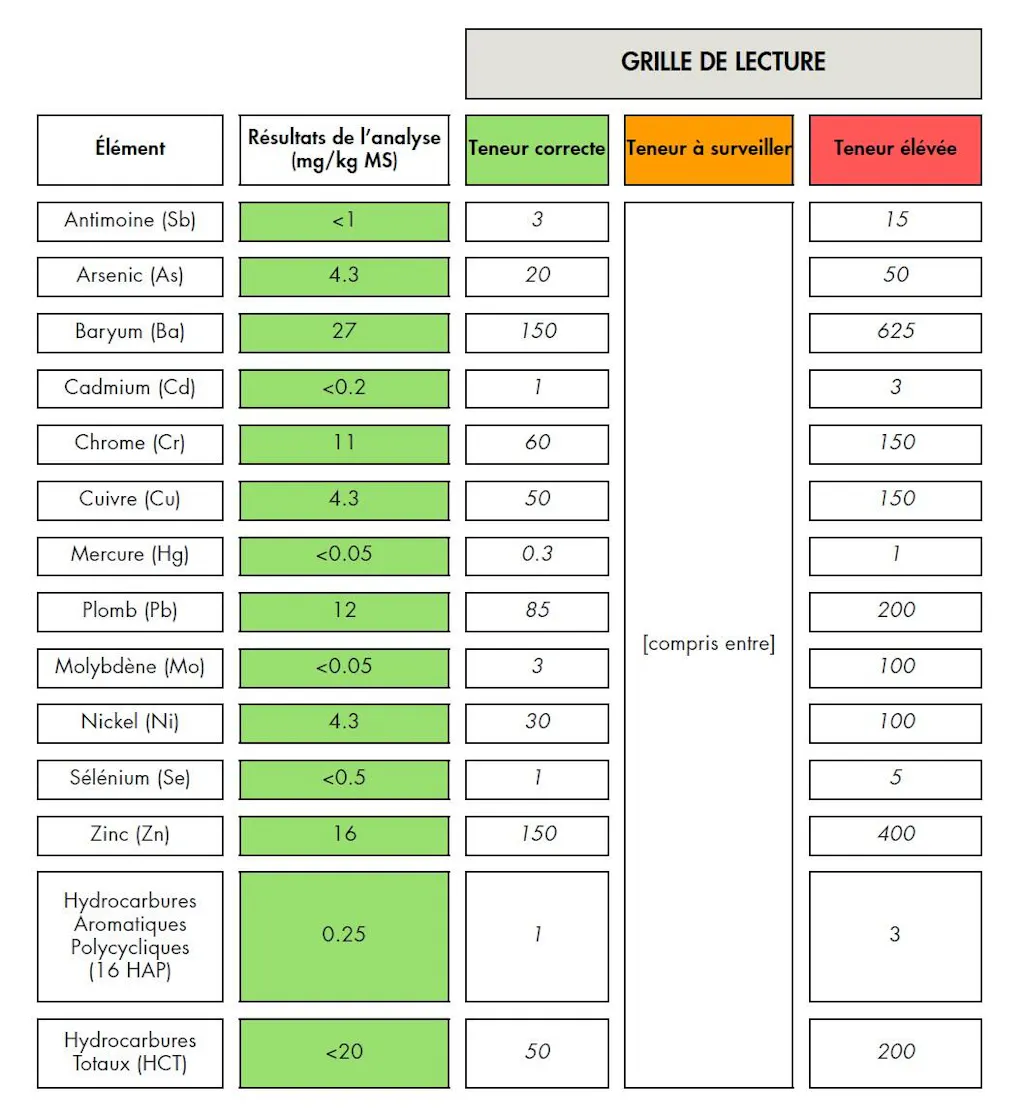
It is possible to analyze your soil with affordable kits like those offered by Pouryère , which allow you to detect more than 200 elements, including PCBs, PAHs, BTEX, heavy metals, PFAS.
Je recommande. Tout s'est très bien passé. En trois semaines j'ai reçu les résultats. La communication avec la société est excellente. J'ai bien été tenue informée de l'avancée du process au fur et à mesure.