PAH Analysis: The complete guide to understanding, detecting and treating soil pollution by polycyclic aromatic hydrocarbons
|
|
Time to read 11 min

|
|
Time to read 11 min
Summary
Do you have land suspected of being polluted by hydrocarbons ? Are you the owner of an industrial wasteland, a former service station or an agricultural site? PAH (Polycyclic Aromatic Hydrocarbons) analysis is undoubtedly one of the most important steps before any development or sale project.
But what is the purpose of this diagnosis? Why is hydrocarbon pollution so dangerous for the environment and human health? And above all, how do we interpret the results and what solutions exist for decontaminating polluted soil?
This comprehensive guide explains everything you need to know about PAH analysis : from sampling to remediation, including standards, costs and concrete examples.
PAHs , or Polycyclic Aromatic Hydrocarbons, are organic chemical compounds formed by the incomplete combustion of fossil or organic materials (oil, coal, gas, wood, etc.).
They can be found in particular in:
PAHs are much more than just an industrial residue: they are persistent pollutants capable of transforming land into a veritable ecological time bomb. Why?
In other words, without PAH analysis , it is impossible to have a clear view of the extent of pollution by hydrocarbons and other soil pollutants present on a site.
One might think that this diagnostic only concerns large industrial companies, but that's wrong. PAH analysis is essential in many cases:
Beyond the legal obligation, it is primarily a strategic decision-making tool . Knowing the level of contamination helps avoid enormous additional costs for unforeseen remediation work. It also prevents any health risks to humans and living beings.
In France, as in Europe, the monitoring of PAHs is governed by several standards and directives. Among the most important are:
The permissible limit values for PAH concentration in soil vary according to the intended use of the land, due to the different levels of health and environmental risk associated with it.
Wondering how experts detect the presence of PAHs in soil? As with total hydrocarbon analysis , PAH analysis follows a precise protocol to guarantee reliable results. Here are the four key steps, from site investigation to concrete solutions.
Before carrying out any sampling campaign, it is essential to conduct a preliminary study of the site .
This step aims to:
Based on these elements, a sampling plan is established, specifying:
Soil samples must be collected in accordance with the sampling plan, in order to accurately represent the condition of the site .
Best practices:
Once the soil samples have been taken, they are analyzed in an accredited laboratory to determine the presence and concentration of polycyclic aromatic hydrocarbons (PAHs) .
This step includes several technical phases:
The laboratory specifically targets the 16 PAHs considered priorities by the US Environmental Protection Agency (US EPA), including:
Naphthalene (C₁₀H₈)
Chrysene (C₁₈H₁₂)
Benzo[a]pyrene (C₂₀H₁₂, known for its carcinogenic properties)
These compounds are being sought because they present significant health and environmental risks .
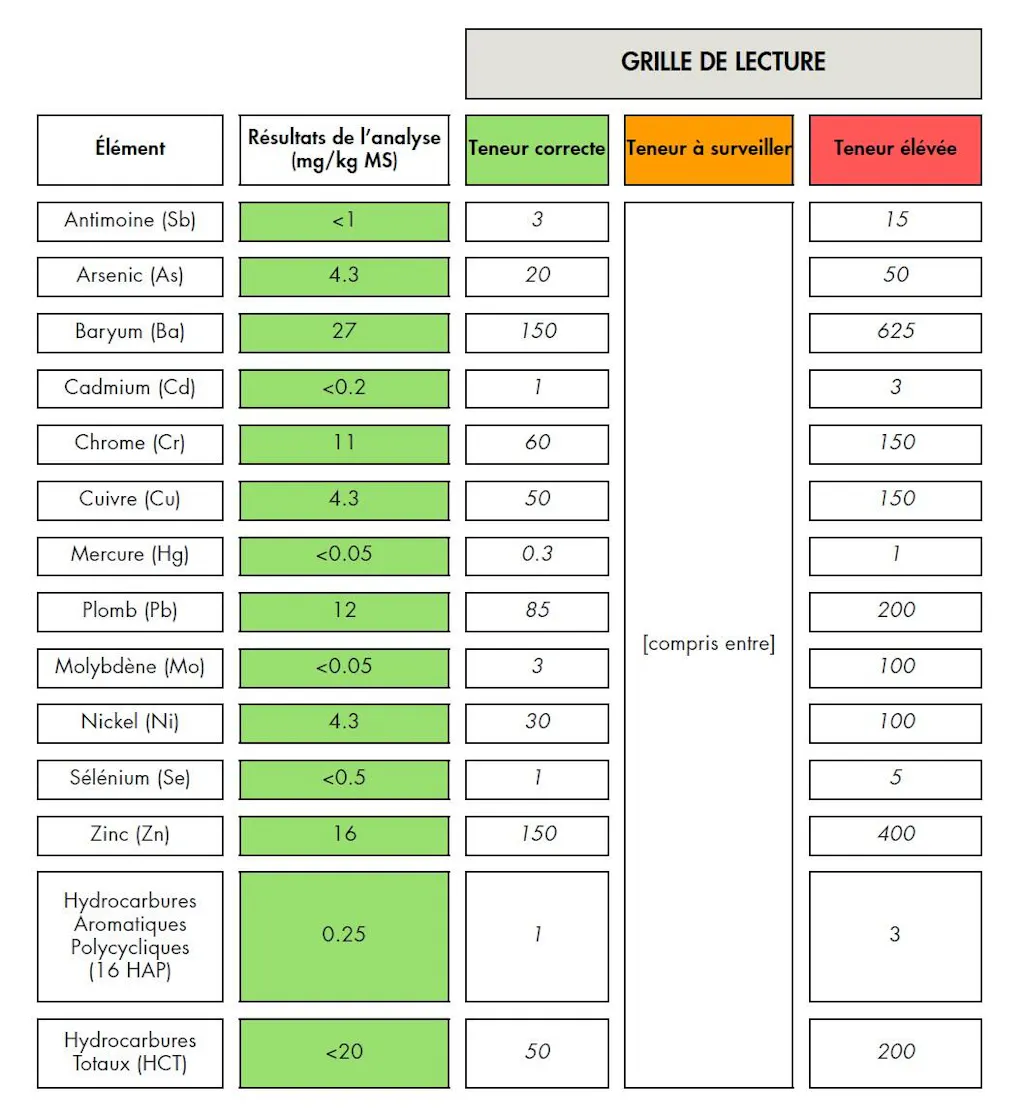
Following the analyses, the raw and interpreted results ( concentrations of each PAH in mg/kg of dry soil) are compared to national regulatory threshold values (e.g., thresholds of the French decree on polluted sites and soils) or, failing that, to international guideline values (US EPA, WHO).
If concentrations exceed critical values, a remediation plan is recommended (excavation and treatment of soil, thermal desorption, bioremediation).
If the cleanup is too complex, a containment and monitoring plan can be put in place (geomembrane, cover, regular monitoring of groundwater).
The final report must include :
The price of a PAH analysis varies according to several criteria:
On average, the cost is between €150 and €400 per sample , depending on the complexity of the analysis and the total volume.
The choice of remediation technique depends on several factors: level and depth of pollution, type of soil, regulatory constraints and future use of the site (for example: redevelopment into a residential, industrial or green space area).
The main solutions are:
An expert will determine the best strategy, sometimes by combining several methods.
Only an ISO 17025 accredited laboratory can provide reliable and usable results:
PAH analysis is much more than a simple chemical test. It is a tool for protecting the environment, public health, and real estate investments .
It allows you to:
The author of the article: Joseph OLIVIER
Joseph Olivier is an entrepreneur in the environmental sector. Originally from Nantes, he trained in waste management before creating a circular economy consulting firm . In 2022, he co-founded Pouryère with the ambition of addressing citizens' concerns about soil quality in France and access to environmental data.
Ignoring polycyclic aromatic hydrocarbon (PAH) contamination exposes landowners to several significant risks. Firstly, there is a legal risk, as the landowner may face prosecution for failing to report pollution, potentially resulting in fines or costly remediation obligations. Secondly, the financial costs associated with emergency remediation or remediation following a worsening of the pollution can increase considerably. Finally, health risks must not be overlooked, as PAHs are carcinogenic and mutagenic pollutants that can seriously harm the health of residents and land users, not to mention the environmental impact, with the potential spread of pollutants into groundwater and to local wildlife.
It is legal to sell contaminated land, but the seller is obligated to inform the buyer of the presence or suspected contamination. In this context, a PAH analysis becomes mandatory to assess the soil condition and provide the buyer with an accurate diagnosis. This analysis report is included in the technical diagnostic file (DDT) provided at the time of sale, as failing to inform the buyer could lead to disputes and jeopardize the transaction.
Financial responsibility for remediation depends on the specific circumstances of the site. In most cases, the current landowner is responsible, especially if they are the source of the pollution or if no previous polluter can be identified. If the historical polluter is known, they may be legally compelled to finance the remediation according to the "polluter pays" principle. Furthermore, public assistance is available, notably through ADEME (the French Agency for Ecological Transition) or certain local authorities, which can provide financial or technical support for remediation operations under certain conditions. Finally, environmental insurance policies may partially cover these costs, although coverage varies from one contract to another.
It is possible to live on land contaminated with PAHs provided that strict measures are implemented, such as containment measures like covering the soil or installing impermeable paving slabs, or partial remediation aimed at reducing the risk of exposure. Regular environmental monitoring, including soil and groundwater testing, is also often recommended. In some cases, it may be advisable to limit or adapt the land use, for example, by reserving it for non-residential areas or green spaces, and these decisions must be made in consultation with the relevant authorities such as the Regional Directorate for the Environment, Planning and Housing (DREAL) or regional health agencies.
Pouryère supports you throughout the entire soil analysis process. Our sampling kits come with a comprehensive guide to walk you through the process. Once you've completed the analysis, simply send us your samples for full analysis and interpretation, which takes approximately ten days.
Each soil analysis kit is specialized and pursues a specific purpose:
 HCT Analysis: A Complete Guide to Understanding Everything
 Soil pollutants: what are they, where do they come from, and how can they be detected?

Soil analysis: a true health check for your land
Related product
POLLUKIT: Soil Pollutant Analysis
199,00€